
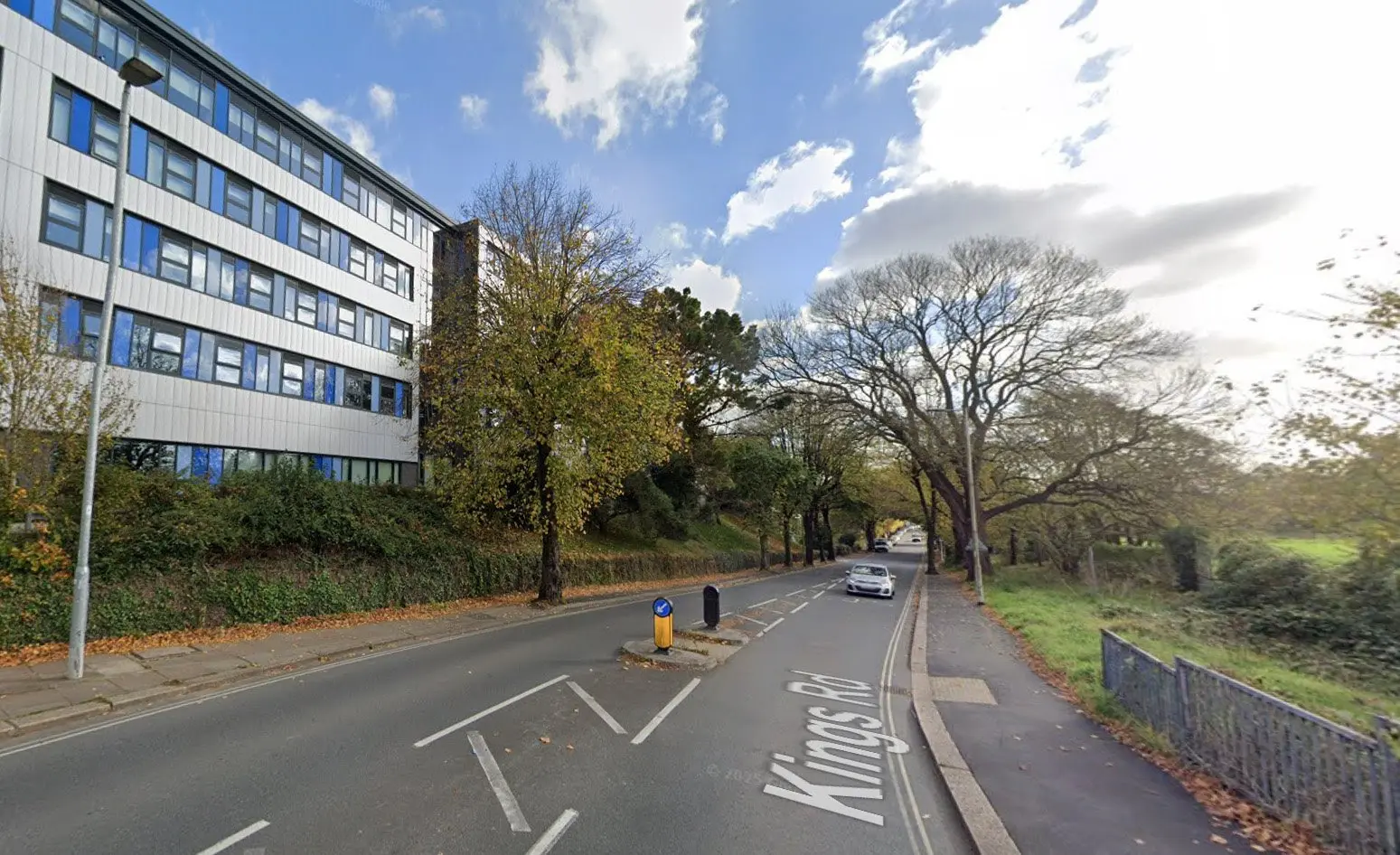
Following a solicitor's letter from STRAW, Plymouth City Council have agreed that they will not act on the unlawful consultation they ran with regards to the proposed felling of 4 street trees on Kings Road.
Our letter made clear that should they fell any trees before consulting properly, they would be acting unlawfully.
We also said:
Importantly, it did not provide enough accurate information to enable intelligent consideration of the scheme, i.e., by not giving proper reasons why the trees needed to go and by giving people the impression that the trees were in some way responsible for fatal accidents.
We asked them to consult again, give people accurate and sufficient information, which is not misleading, and that comments should be conscientiously taken into account before a decision is made.
After another consultation, PCC will also have to publish their decision along with their reasons, and wait 28 days before felling any trees - no rushed nighttime felling operations when nobody expects it.
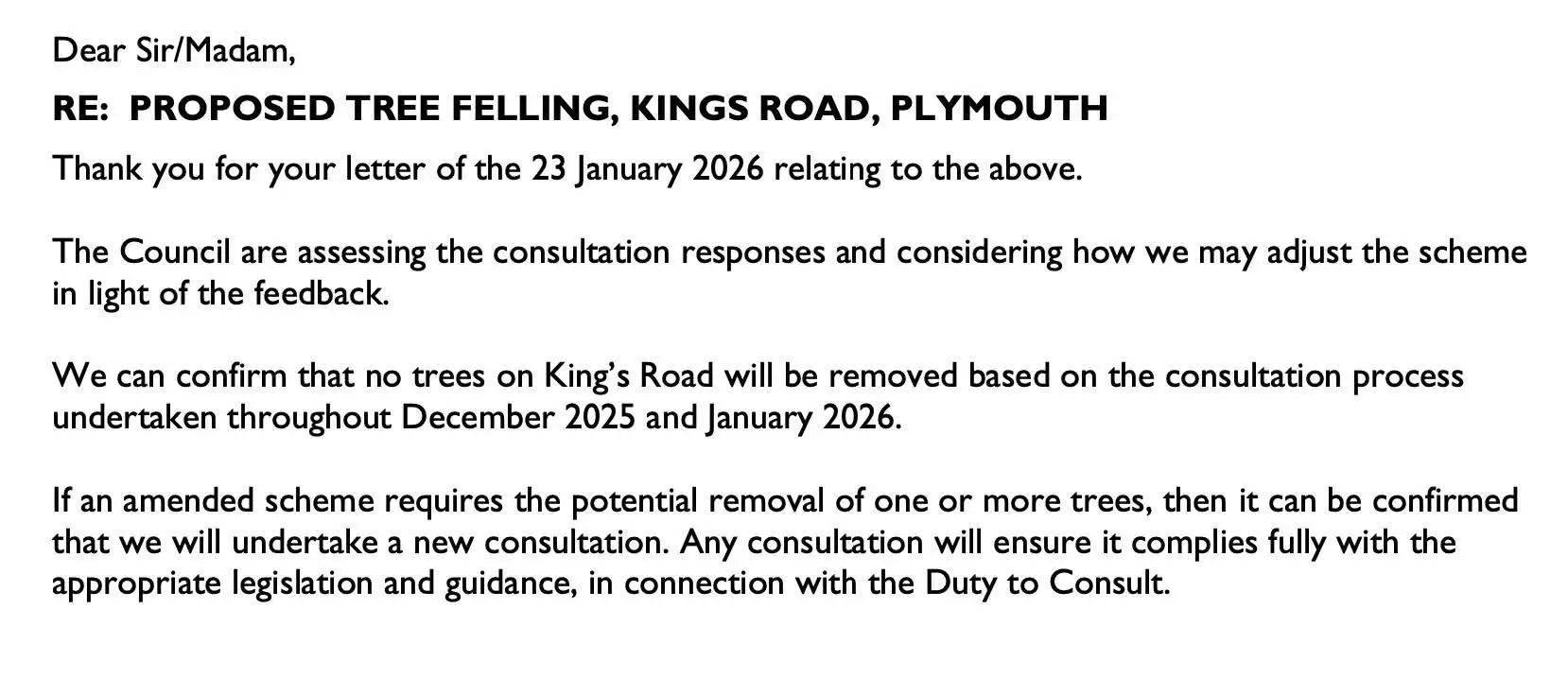
It's not clear from PCC's response whether they will propose a less destructive scheme or not (let's hope so), but they have confirmed that no trees will be felled as a result of the consultation they just ran (certainly a kind of admission that it was unlawful), and that should a future proposal require tree felling, they will run a consultation which will actually comply fully with the appropriate legislation and guidance.
At a recent committee meeting, a ward councillor for Stoke, where the trees are, Cllr Tom Briars-Delve, said that this scheme is a pilot for applying some of their new values. It's a pity then that they are not even meeting their legal obligations to consultation, let alone, being honest and transparent with residents about the details.
He went on to say that there have been multiple fatalities on what he described as a "very dangerous stretch", and that the local residents live in fear of road safety and the risk in the neighbourhood. He goes on to say that he thought that keeping the 4 trees would “be very hard to justify based on the recent fatalities”.
You can watch the meeting here.
According to collision data, there have been 2 fatal accidents on Kings Road in the last 5 years. Of course, a fatal accident is undoubtedly a very tragic thing, but is it right to blame the trees for these accidents?
A young motorcyclist very sadly died in May 2025. On the day of the accident, the road was closed halfway along and it was reported that the coroner said that “He was riding his motorcycle when he collided with a car performing a manoeuvre in the road”. Presumably, the car was turning around in the entrance of Rectory Road because it had reached a dead end caused by the road closure.
It’s fair to say that the trees can’t be blamed in this case.
The other fatal accident occurred in 2022 and also involved a motorcyclist who was sadly killed by the driver of a minibus.
This article covers how the minibus driver pleaded guilty to causing death by dangerous driving and was then sentenced to 6 years in prison after being convicted of driving under the influence of a controlled drug. The accident happened at 5.30 am, and he had just driven to Bristol and back, so it's probably fair to say he might have been tired. Not only had he been taking cocaine, but he had also not been properly monitoring his blood sugar levels (he’s a diabetic) prior to rolling through a stop sign. His track record at driving was questionable to say the least. He had only just got his licence back, having previously been disqualified for driving or attempting to drive with a drug level above the specified limit and unbelievably, between killing the father of 4 and his sentencing, he committed two further driving offences.
The accident did not happen near the trees PCC want to fell, but over 40 metres away, and, in fact, there are 4 trees in between where the accident happened and the nearest one they want to cut down, plus 2 on the other side of the road.
The extent to which these tragic deaths are being used by PCC to justify the loss of mature trees is worrying when the accidents were seemingly in no way influenced by the trees. And some of the things said in this meeting by Cllr Briars-Delve were really disappointing. Perhaps PCC have learned that as long as they pin tree loss on the coattails of a tragedy, it’s easier to get away with it.
It was also genuinely worrying listening to Cllr Briars-Delve, who is the Cabinet member for the Environment and Climate Change and the Chair of the Plan for Trees Steering Group, state that:
"...those are category C trees, in terms of their assessment, which means that they would be unlikely to live longer than 20 years if they continued in situ as they have done. So they would be needing to be felled anyway because of risk down the line..."
The London plane is a Category B tree and national guidance says efforts should be made to retain them.
The Joint Local Plan states that:
"Development should be designed so as to avoid the loss or deterioration of woodlands, trees or hedgerows".
It is in an area of very low tree equity and the recently adopted Plymouth Plan for Nature and People states that:
"...in communities in tree-poor neighbourhoods who are disproportionately affected by environmental hazards like extreme heat and pollution".
The vast majority of urban trees in Plymouth are Category B so why is Cllr Briars-Delve suggesting that they might as well fell it because they'd have to do so in the future? Does that mean we might as well get rid of most trees? Just like with Armada Way when the Council continually repeated that the trees didn't have a long healthy life left (which was untrue), Cllr Briars-Delve said that the trees are “nearing the end of their healthy life”. Of course, sometimes trees need to be felled for development or for safety reasons but in this case, PCC has not made the case to justify felling these trees and it appears that the decision to fell them has been made because it is convenient. The balance has not adequately considered the value or benefits provided by these trees.
None of the trees on Kings Road planned to be felled have been classed as unsuitable for retention. The newly planted trees will not be providing the area or wildlife with the eco-system services these trees are for decades.
The canopy cover where all these trees are is below average for Plymouth at only 16%.
Details below are based solely on our observations and an email from a Senior Traffic Engineer. Do go and have a look at the trees and the plans yourself before responding to the consultation. And please urge them to restart it, in line with the guidance.
All comments are taken from the email from the PCC Senior Traffic Engineer in italics and our comments are in bold.
“The zebra crossing is a planning condition of the Foulston Park Development.”
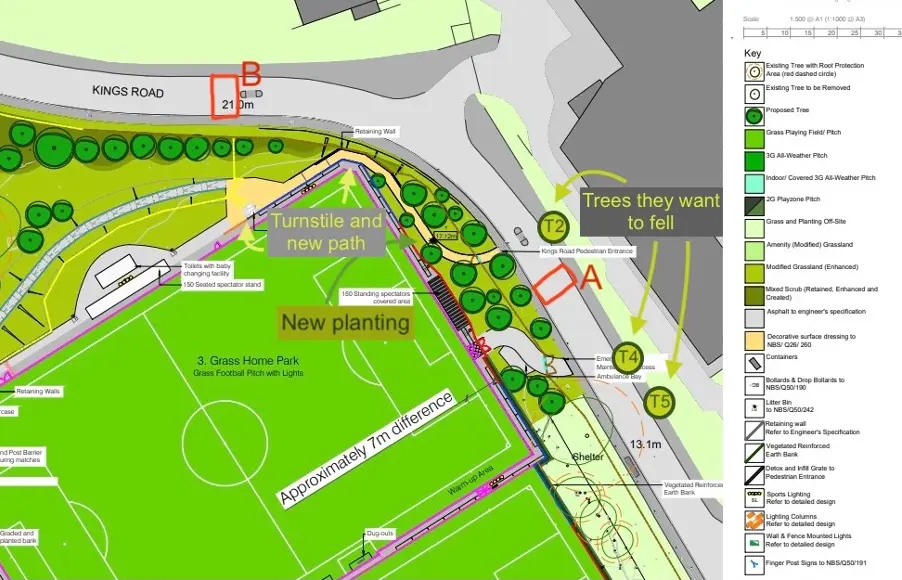
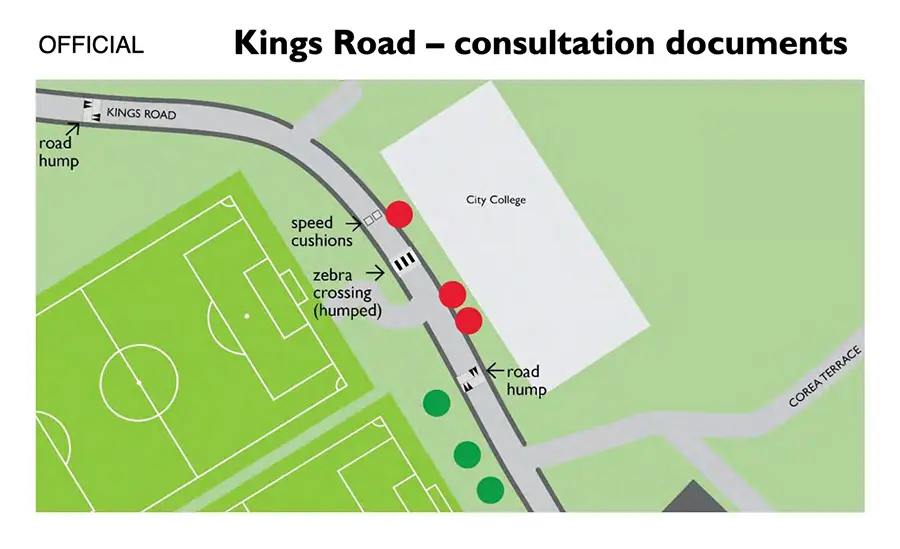
I don’t know how the developer is expected to fulfil planning conditions which fall outside of the boundary of the development (and would require further public consultation) but even so, the conditions are vague and do not state that the crossing should be exactly where it has been proposed (location A on the map below). In fact, according to the consultation page, the proposed crossing is south of the current uncontrolled crossing, maybe 3 or 4 metres from the tree they want to fell.
The conditions do not state it must be a zebra crossing but could be a signalised crossing and I’d say it doesn’t need to be where it has been proposed but it could be in the place where the other existing uncontrolled crossing is (location B), which is much clearer of trees. There is room there to position it the same distance from the bend in the road and install additional lighting. I’m not suggesting it should be a signalised crossing, just that the condition they are relying on is vague and does not stipulate that PCC do what is being proposed therefore that the statement by the senior traffic engineer (above) is misleading.
“There are no other safe or suitable locations in the area for this crossing.”
This statement is not expanded on in any way. According to the guidance on the legal duty to consult, the council should provide “any engineering or tree management solutions considered by the local highway authority as an alternative to felling the street tree or trees”. They have not done this.
The trees proposed to be felled are not dangerous and they have been classed as Category C trees, not Category U trees (which are unsuitable for retention) therefore efforts should be made to retain them.
“When providing pedestrian crossings there are both regulatory and safety considerations which must be considered.”
“Crossings themselves must be placed on or close to the desire line already used by pedestrians or to be established as part of a development. There would be little point on placing a crossing at a location where pedestrians do not cross. The northern crossing provides a link between the City College Campus and Playing Fields/Pedestrian Access to Foulston Park on the opposite side of the road.”
PCC recently installed a zebra crossing on Mill Bridge which does exactly this. It’s about 10m too far over from the place where people naturally cross the road, as a result it is rarely used, so yes, I agree with this bit!
The proposed crossing on Kings Road (location A) is in an odd place and overshoots the entrance to City College. In our opinion, it’s not on a desire line, and the other crossing (location B), would be a more sensible place to position a crossing. More information would be nice, but of course, we can only go on what we have.
“Crossings must also be placed at a point where there is adequate inter-visibility between drivers and pedestrians using, or about to use, the crossing. Bends are therefore to be avoided as are stretches of road where there are mature trees in place as these will obstruct visibility and often render footway approach to the crossing difficult, particularly for the mobility impaired. Where trees are in place, we will follow the mitigation hierarchy and through this every effort will be made to avoid removal although this is sometimes unavoidable.”
“When establishing a Zebra Crossing there is a legal requirement to light the approaches and floor of the crossing to the lighting standard specified in BS 5489. If Plymouth Highways were not to apply this standard, a collision and injury might result and the City Council would find the position difficult to defend, in the event that legal proceedings were to follow.”
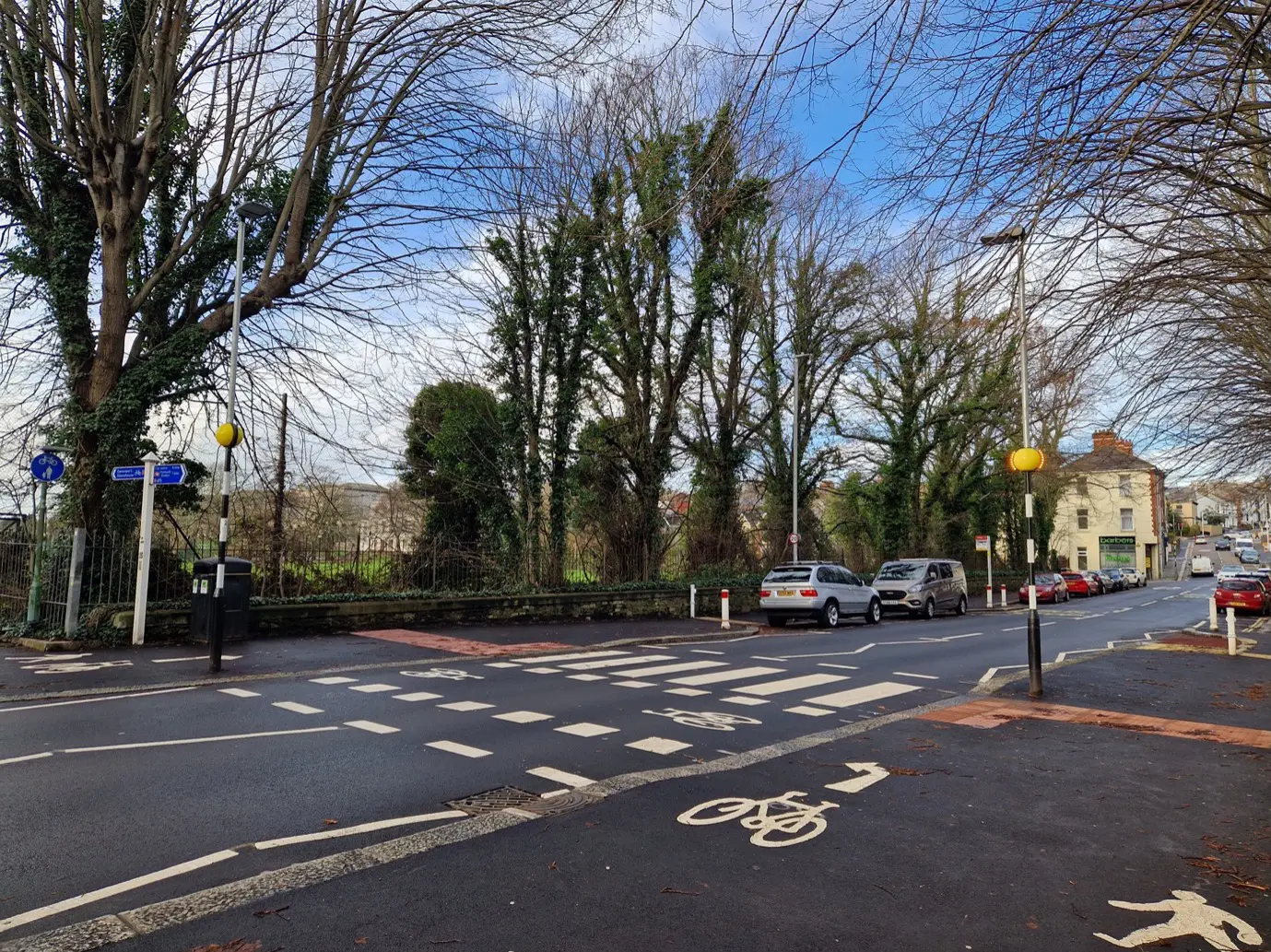
The new zebra crossing on Mill Bridge, which I just mentioned is also in an area which is tree lined. No trees were felled in order to install the crossing and the lighting which surrounds the crossing could readily be replicated on Kings Road.
On Mill Bridge, there are Belisha beacons on either side of the crossing, which have short lampposts integrated into them; they are beacons and lampposts. Other taller lampposts are 19m and 12m away and are both on the same side. At location A, there are already lampposts on either side of the road and this type of Belisha beacon could also be installed.
“An assessment by the City Council’s Street Lighting Engineer has indicated that in order to light the northern Zebra Crossing to BS 5489, 2 further trees will have to be removed as their foliage will interfere with the required lighting level either side of and on the crossing”.
I genuinely have no idea what this is all about and suspect there is another reason they want these two gone. These 2 trees (T4 and T5) are approximately 25m away from the proposed crossing, and the location of the crossing has a street lamp right next to it. The locations of these two trees on the consultation information (lower 2 of the 3 red blobs) are a bit misleading and make it look as though they are closer to the proposed crossing location than they actually are.
The engineer cited the BS 5489 a couple of times which is the British Standard guidance on the Design of Road Lighting. But he didn’t mention this part…
Part 6.1.2 of BS 5489, states:
In tree-lined roads, lower mounting heights than usual may be used to bring luminaires below the tree canopy.
“The Road Safety Audit for the scheme found that the location of an existing tree (T2) in close proximity to the site of the proposed Zebra crossing on the northern section of Kings Road (location A). As such they are concerned that the tree could compromise intervisibility between passing drivers and riders and crossing westbound pedestrians, particularly in the growing season. This in turn could lead to heavy braking, shunt type collisions and the potential for collisions with crossing pedestrians. Additionally, the tree could compromise conspicuity of the proposed Belisha beacon at night which in turn could increase the potential for collisions at the crossing during the hours of darkness.”
The space between the trees is approximately 30m. Couldn’t the crossing be positioned slightly to the south, within this space? It would therefore be further away from the bend on the road?
A similar tree is planned to be retained very close to the other Zebra crossing at the southern end of Kings Road. Why is this one okay but not T2? If the crossing were positioned a few metres to the south, it would be clear of this tree.
Has the council considered building out the kerb by any of the trees to accommodate them? This could be incorporated into the traffic calming scheme.
“This tree (T2) has also been involved in a vehicle collision resulting in a serious injury within the last 5 year period and has been judged to have a very short residual life span by an arboriculturist.”
Was the tree the actual cause of the accident?
Tree lined streets have been proven to reduce vehicle speeds. And if a car comes off the road and hits a tree, isn’t that preferable to them hitting a pedestrian?
Has reducing the speed limit been considered to improve road safety?
“It was not considered possible to extend the footway at this location to the extent required to mitigate the effect of the tree on the crossing.”
It’s not clear what this means.
“The southern crossing location was chosen as an upgrade to an existing uncontrolled crossing serving pedestrians crossing Stonehouse Bridge to travel up Devonport Hill and Stonehouse Creek Car Park crossing to access the Pedestrian route to Foulston Park. Both Stonehouse Creek Car Park and City College are designated parking areas for Foulston Park. Again, the constraints here are the junctions onto Stonehouse Bridge and into Stonehouse Creek Car Park as well as line of mature tress further north along Kings Road. The location chosen was considered to be the most suitable considering these constraints.”
If the crossing is to serve people walking between Foulston Park via Devonport Hill and Stonehouse Creek Car Park, the crossing could go almost anywhere between the existing uncontrolled crossing and the entrance to the car park; it does not need to be exactly where the current crossing is.
The tree proposed to be felled is a Category B tree and therefore should be retained unless there is a very good reason to remove it, which has not been demonstrated.
“An assessment by the City Council’s Street Lighting Engineer has indicted that in order to light the southern Zebra Crossing to BS 5489, one further tree will have to be removed as its foliage will interfere with the required lighting level either side of and on the crossing.”
There is a tall street light currently next to the tree and the light is within the foliage of the tree. There is no reason for this light to be this tall and it could be reduced in height as per guidance in BS 5489.
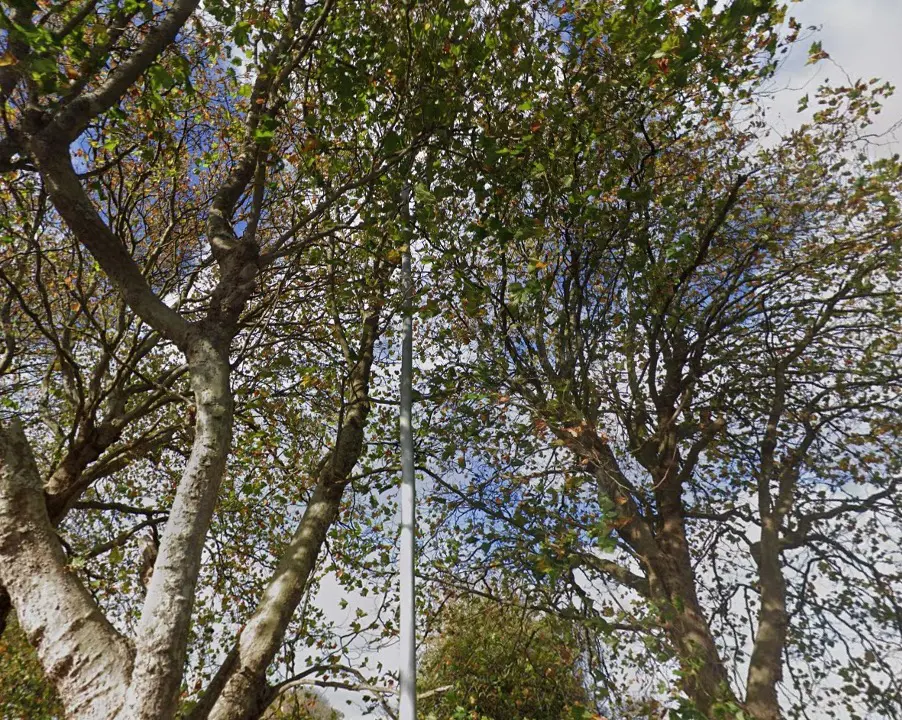
Alternatively, there is plenty of room to install a new street light closer to the location of the new crossing and install Belisha beacons with street lights, as has been done on Mill Bridge.
Presumably, the cost of the work will be a consideration on how it’s designed and it’s likely to be the case that the Foulston Park developer (Plymouth Argyle Football Club) will need to cover the cost of the work on Kings Road if it is a planning condition. So are the PCC traffic engineers suggesting a design which saves the football club money by installing fewer new lampposts at the expense of publicly owned mature amenity trees? If you have any experience in this area, do let me know.
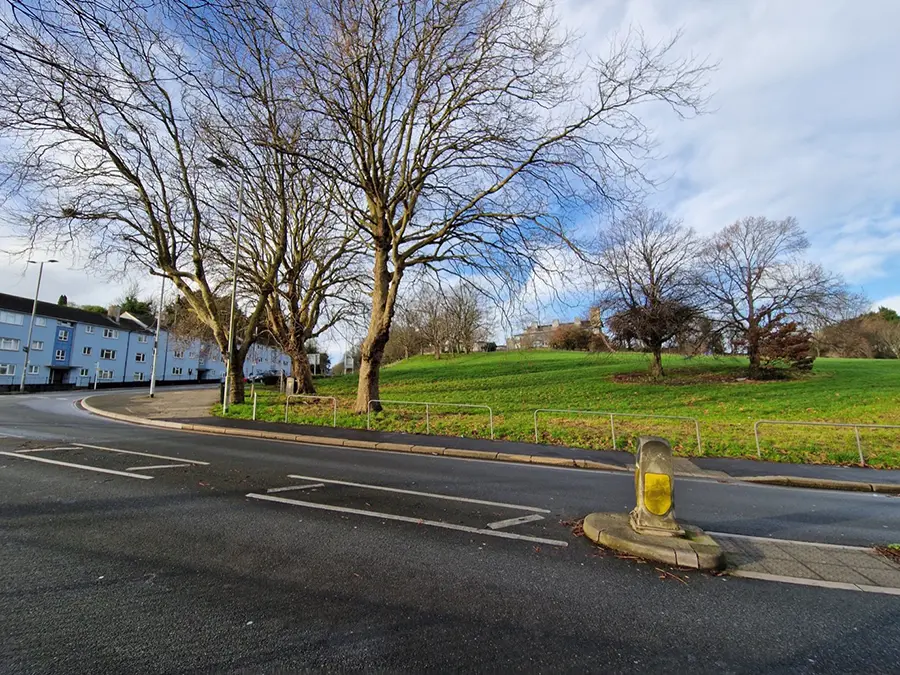
The tree they want to fell is at least 12m from the proposed crossing, not even on the pavement and not even the closest tree to the location of the crossing (furthest left tree in the above photo). This tree is in a very low tree equity score area and should be retained.
In our opinion, the plan to fell this Category B tree represents an appallingly lazy approach to urban design and the planning of the new crossing. It shows no sign of balancing the benefits provided by this mature, amenity tree with the convenience of felling it.
The consultation runs until January 23rd.
You can respond via
https://www.plymouth.gov.uk/traffic-and-road-safety-schemes
Click on Kings Road (2137351) for details.
Alternatively you can write to:
Service Director for Street Services (Plymouth Highways),
Plymouth City Council,
Ballard House,
West Hoe Road,
Plymouth,
PL1 3BJ.
You must quote the reference: Amd.2025.2137351 Kings Road
Additional potentially relevant references from BS 5489
6.1.1
Intersections, pedestrian crossings, bends, gradients, and crests of hills occur frequently and their particular lighting might require compromise.
6.1.2
In tree-lined roads, lower mounting heights than usual may be used to bring luminaires below the tree canopy.
4.2.2.1
The design and siting of road lighting and other road equipment can make a great difference to the street scene, even though this might not be consciously appreciated. In situations such as a processional way or monumental bridge, the design and placing of lighting columns can make a positive formal contribution to the scene.
More usually however buildings, trees, paved surfaces, grass and people provide all the interest required.
7.4.11 Lighting of parks and landscaped areas
If adjacent to trees with descending branches, floodlights can be placed underneath or within the trees.
7.5 Lighting conflict areas (which include crossings)
The use of a smaller number of luminaires at higher mounting heights than 12m, or high mast lighting, can be practical and economical solutions for complex or large single level junctions.
But it is not mandatory.
Relevant section from Manual for Streets 2
10.7.2
The impact of other obstacles, such as street trees and street lighting columns, should be assessed in terms of their impact on the overall envelope of visibility. In general, occasional obstacles to visibility that are not large enough to fully obscure a whole vehicle or a pedestrian, including a child or wheelchair user, will not have a significant impact on road safety.
Keep up-to-date with our campaign
Join our mailing list to be kept up to date about issues in Plymouth which relate to trees and local governance.
Thank you.